
Why Dog Waste Smells the Instant It Lands — and Why Flies Find It So Fast
Most people think the smell means the poo is starting to rot. It isn't — not yet. Much of that smell was already made inside your dog, before it ever touched the ground. Here is what is actually in the odour, where it comes from, and why flies arrive so quickly.
Category: Dog Waste Odour & Science
Relevance: BioLock Active Odour & Fly Context
If you have a dog, you already know the sequence by heart. Your dog goes, the smell hits you almost immediately, and within what feels like seconds, the flies have found it. Pick it up an hour later, and there are more. It is so consistent that most of us never stop to ask the obvious question: why is the smell instant? If decomposition is what makes things stink, and decomposition takes time, the smell should build slowly — not arrive the moment the waste does.
The answer is genuinely interesting, and once you understand it, everything about managing dog waste odour makes more sense. The short version: A large part of the smell was already being made inside the dog, by the bacteria in its gut, before it ever came out. The waste arrives carrying that odour load — which is why the smell is instant. And the microbial activity that produced it does not switch off when the waste lands; it carries straight on, and the change of environment makes it intensify quickly. So the smell is immediate because the chemistry was already underway, and it worsens because that same process keeps going.
"The smell isn't the poo starting to rot when it lands. It's a microbial process that was already running inside the dog — and carries on, faster, once it's out."
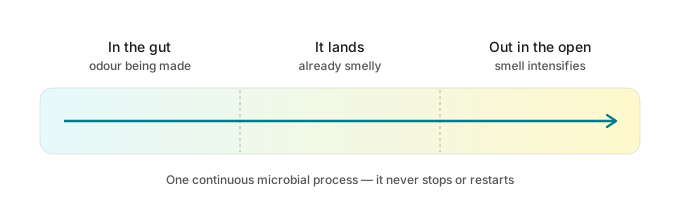
The smell starts in the gut, long before the lawn
Your dog's large intestine is a busy fermentation tank. Trillions of gut bacteria break down whatever the small intestine didn't fully absorb — leftover protein, fibre, fats. The by-products of that breakdown are exactly the compounds we recognise as "the smell of poo." They are formed during digestion, days before the waste leaves the body, and they are already present in fresh stool the moment it lands.
We know this is true for dogs specifically, not just in theory. When researchers measure the chemistry of fresh dog faeces, they consistently find the classic odour compounds already there — ammonia, the sour fatty acids, phenol, and indole — and they find more of them when dogs are fed high-protein diets, because protein is the raw material the gut bacteria turn into the smelliest products.[1,2,3]Much of the smell, in other words, is a product of digestion that is already well underway before the waste lands — the lawn is just where you first notice it, and where it speeds up.
What is actually in the smell
"Dog waste smell" is not one chemical. It is a blend of several families of compounds, each with its own character, and each produced by a different part of the digestion-and-decay process. Studies of faecal odour routinely identify hundreds of individual airborne compounds.[4] But four families do almost all of the heavy lifting, and you can learn to recognise each one.
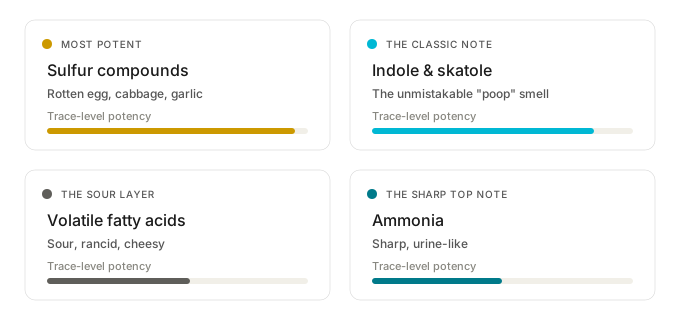
Family 1 — the worst offenders
Sulfur compounds
Hydrogen sulfide (the rotten-egg gas), methanethiol, and the dimethyl sulfides are produced when bacteria break down the sulfur-containing parts of protein. Your nose can detect them at almost unimaginably tiny concentrations, which is why they punch so far above their weight. One landmark study of faecal odour found these sulfur gases were among the compounds most strongly tied to the smell — largely because we detect them at such extraordinarily low concentrations.[5,6]
Family 2 — the classic "poop" note
Indole & skatole
The unmistakable faecal smell
These two are made when gut bacteria break down tryptophan, a building block of protein. Skatole in particular is the compound most people would name "the smell of poo," and it is detectable at trace levels far below a part per million.[7] Curiously, in pure crystal form, skatole smells almost floral — it is only at the right (low) concentration that it reads as faecal.
Family 3 — the sour layer
Volatile fatty acids
Sour, rancid, cheesy, vinegary
Acetic, propionic, and butyric acids come from bacteria fermenting carbohydrates and protein. Butyric acid is the rancid-butter, sweaty-sock note; the branched versions from protein breakdown are among the more offensive. These are the "sour" backdrop underneath the sharper sulfur and faecal notes.
Family 4 — the sharp top note
Ammonia
Sharp, urine-like, eye-watering
Ammonia is the pungent, nose-stinging note. It forms when the enzyme urease splits urea, and urease is one of the fastest enzymes known. Left alone, urea would sit unchanged for years; once urease reaches it, ammonia starts forming straight away — a big reason the sharp edge of the smell is there almost immediately. (Working through all the urea then takes hours.)[8]
Then it gets worse: what happens after it lands
So the waste arrives smelly. Why does it then get smellier as it sits, and worst of all if it has been sitting in a warm heap for a few days?
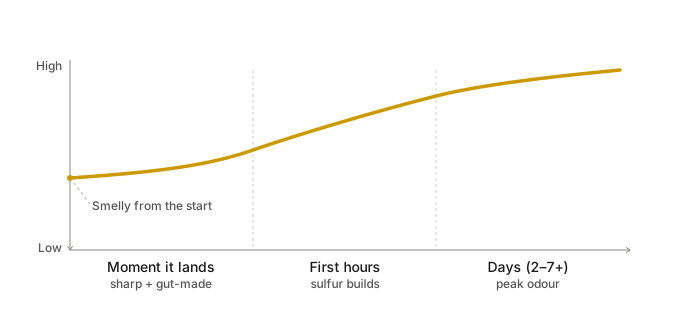
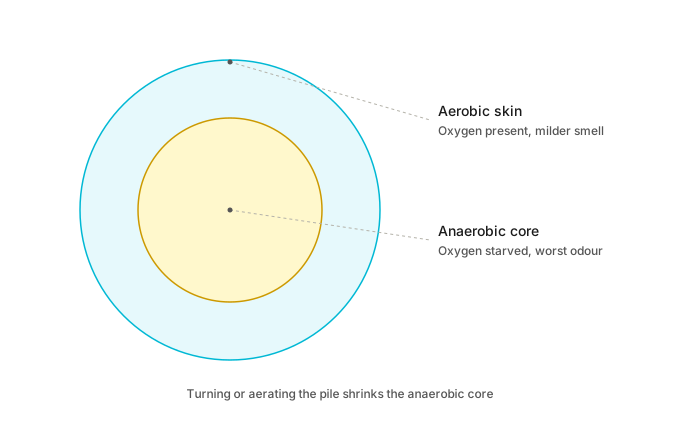
The key is oxygen. Fresh waste still has some oxygen in it, and the bacteria near the surface use it. But oxygen runs out fast inside a moist, dense mass — the bacteria use it up quicker than air can resupply it. Once the inside goes oxygen-starved, a different set of bacteria takes over: the anaerobes, which work without oxygen. And the anaerobes are the ones that pump out the foul sulfur gases and sour acids in earnest. This is why the smell intensifies and shifts over hours and days, and why it peaks once the material has had time to go properly oxygen-starved inside.
| When | What you smell | What is happening |
|---|---|---|
| The moment it lands | Sharp ammonia + the gut-made faecal smell | Odour compounds made during digestion are already present. Ammonia forms almost instantly as urease acts on urea. |
| First hours | Smell deepens and turns more sulfurous | Oxygen inside the waste is used up. Anaerobic bacteria take over and ramp up sulfur compounds and fatty acids. |
| Days (2–7+) | Peak stench — rotten, sulfurous, sour | Anaerobic decomposition dominates inside the mass. This is the foulest, most fly-attracting phase |
Why the flies find it so fast
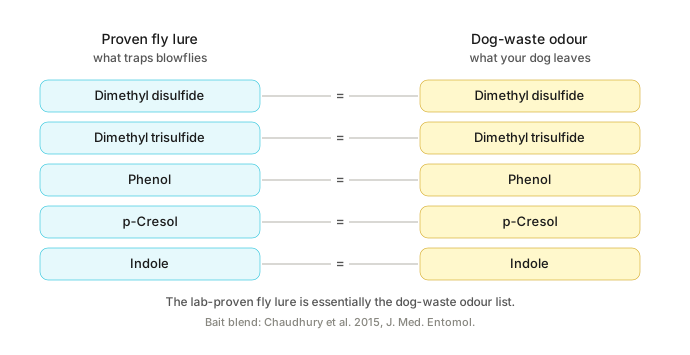
Flies are not drawn to "smell" in the vague way we are. They are equipped with sensors — on their antennae and mouthparts — tuned to detect the exact gases we have just described. The clearest proof is in the lab: when entomologists built a synthetic bait to lure and trap egg-laying blowflies, the recipe that worked reads almost like a checklist of dog-waste odorants — dimethyl disulfide, dimethyl trisulfide, phenol, p-cresol and indole — with the sulfur compounds and indole doing most of the attracting.[10] Houseflies respond to much the same family of manure and decomposition volatiles, together with ammonia and carbon dioxide. To a fly, those gases are not unpleasant. They are a signal. They mean food, and they mean a possible nursery for eggs. So when you watch flies arrive at fresh waste within what feels like seconds, you are watching them respond to a chemical advertisement the waste begins broadcasting immediately — because, as we now know, the chemistry is already there.
There is one nuance worth knowing, because it changes how you control them. Flies will happily feed on fresh waste — that is what you see when they land on a fresh deposit. Egg-laying, though, depends on the species. Houseflies, the ones in most yards, readily lay their eggs on fresh faeces, so fresh dog waste isn't something that becomes prime breeding material — it can be prime breeding material from the moment it lands. Some flies behave differently: the common green bottle fly, for instance, treats dog faeces more as a feeding stop, with egg-ready females preferring carrion instead.[13] The practical upshot points one way, regardless: deal with the waste early. At warm temperatures, a housefly goes from egg to adult in only about 7–10 days, so clearing waste within a day or two genuinely interrupts the next generation rather than just removing today's nuisance.
"To a fly, the smell isn't a warning. It's an address. The faster waste advertises, the faster they arrive."
How this connects to BioLock Active
Understanding all of this is what makes the BioLock Active approach make sense. If the odour is a chemical signal that is already present and that flies use as an address, then the goal is simple to state: stop the signal from getting out, and stop flies from reaching the surface that produces it.
Covering fresh waste with mealworm frass does two things we can stand behind firmly. First, a complete physical layer over the surface blocks both the escape of the gases and the flies' access to the waste — coverage, not a light sprinkle, is what matters. Second, frass sits at a near-neutral pH, and the sharp ammonia note is strongly pH-driven; keeping the surface from turning alkaline should curb how much ammonia escapes as gas, though how large that effect is in practice is exactly the kind of thing we want to measure rather than assert.
Where we are honest about the limits of what we know
There is a third possibility that is genuinely promising but that we will not overstate. Research on insect-associated microbes shows that introducing a competing microbial community to decomposing waste can shift its odour chemistry — one study found that inoculating food waste with black soldier fly larvae significantly cut the production of the worst sulfur gases, by changing which bacteria dominated.[11] Mealworm frass carries its own living microbial community, so the same kind of effect is plausible. But that specific study was done with a different insect on different waste. Whether mealworm frass shifts the odour chemistry of dog waste in the same way has not been tested. We treat it as an open question, not a claim — and it is one of the things our user-feedback programme is designed to start answering.
It's fair to ask how much of this was measured in dogs specifically — and the answer is more than you might expect. Studies have characterised the volatile profile of fresh dog faeces directly: one catalogued the compounds released by French Bulldog faeces and found indole and phenol among the principal odorants that shift with diet [12], and another analysed the headspace of canine faeces and identified the specific odorants that flies lock onto.[13] So the dog-specific picture is thin but real, not absent. The honest residual gap is a quantitative one: the exact concentrations of the sulfur compounds — skatole, hydrogen sulfide, methanethiol — coming off dog waste haven't yet been standardised in the peer-reviewed literature
The one-paragraph version
Dog waste smells the instant it lands because much of the odour is already being produced inside the dog by gut bacteria during digestion — sulfur compounds, indole and skatole, sour fatty acids, and fast-forming ammonia are all present in fresh waste from the moment it appears. That same microbial activity does not stop once it lands: as the inside goes oxygen-starved, anaerobic bacteria take over, and the smell intensifies over hours and days. Flies detect those exact gases as a signal and arrive quickly to feed; the yard's dominant flies, houseflies, will also lay eggs on it while it's fresh, which is why dealing with it early matters. And covering it promptly works because you are interrupting a chemical advertisement that was already underway in large part before the waste reached the ground.
References
| [1] | Nery, J., et al. (2012). Influence of dietary protein content and source on colonic fermentative activity in dogs differing in body size and digestive tolerance. Journal of Animal Science, 90(8), 2570–2580. pubmed.ncbi.nlm.nih.gov/22328724 |
| [2] | Swanson, K.S., et al. (2002). Supplemental fructooligosaccharides and mannanoligosaccharides influence immune function, ileal and total tract nutrient digestibilities, microbial populations and concentrations of protein catabolites in the large bowel of dogs. Journal of Nutrition, 132(5), 980–989. jn.nutrition.org |
| [3] | Longitudinal canine faecal microbiome and metabolite study (2022). Rapid shifts and subsequent stabilization in faecal metabolites (including phenol, indole, branched-chain fatty acids and ammonia) after dietary change in healthy adult dogs.Animal Microbiome. ncbi.nlm.nih.gov/pmc/articles/PMC9341101 |
| [4] | Garner, C.E., et al. (2007). Volatile organic compounds from feces and their potential for diagnosis of gastrointestinal disease.The FASEB Journal, 21(8), 1675–1688. faseb.onlinelibrary.wiley.com |
| [5] | Moore, J.G., Jessop, L.D., Osborne, D.N. (1987). Gas-chromatographic and mass-spectrometric analysis of the odor of human feces.Gastroenterology, 93(6), 1321–1329. pubmed.ncbi.nlm.nih.gov/3678751 |
| [6] | Higgins, M.J., et al. (2006). Cycling of volatile organic sulfur compounds in anaerobically digested biosolids and its implications for odors.Water Research/Water Environment Research. pubmed.ncbi.nlm.nih.gov/16629264 |
| [7] | Liu, D., et al. (2018). Indoleacetate decarboxylase is a glycyl radical enzyme catalysing the formation of malodorant skatole.Nature Communications, 9, 4224.ncbi.nlm.nih.gov/pmc/articles/PMC6181972 |
| [8] | Dai, X., Karring, H. (2014). A determination and comparison of urease activity in feces and fresh manure from pig and cattle in relation to ammonia production and pH changes.PLOS ONE, 9(11), e110402.ncbi.nlm.nih.gov/pmc/articles/PMC4232307 |
| [9] | Zhou, Y., et al. (2016). Identification, quantification and treatment of fecal odors released into the air at two wastewater treatment plants.Journal of Environmental Management, 180, 257–263. sciencedirect.com |
| [10] | Chaudhury, M.F., Zhu, J.J., Skoda, S.R. (2015). Response ofLucilia sericata(Diptera: Calliphoridae) to a synthetic oviposition attractant — a five-compound blend of dimethyl disulfide, dimethyl trisulfide, phenol, p-cresol and indole, with the sulfur compounds and indole most important for attraction and egg-laying.Journal of Medical Entomology, 52(4), 527–531.pubmed.ncbi.nlm.nih.gov/26335458 |
| [11] | Michishita, R., Shimoda, M., Furukawa, S., Uehara, T. (2023). Inoculation with black soldier fly larvae alters the microbiome and volatile organic compound profile of decomposing food waste.Scientific Reports, 13, 4439.nature.com/articles/s41598-023-31388-z |
| [12] | Urrego, M.I.G., Pedreira, R.S., Santos, K.D.M., Ernandes, M.C., Santos, J.P.F., Vendramini, T.H.A., Eberlin, M.N., Balieiro, J.C.D.C., Pontieri, C.F.F., & Brunetto, M.A. (2021). Dietary protein sources and their effects on faecal odour and the composition of volatile organic compounds in faeces of French Bulldogs. Journal of Animal Physiology and Animal Nutrition, 105, 65–75. https://doi.org/10.1111/jpn.13605 |
| [13] | Brodie, B.S., Babcock, T., Gries, R., Benn, A., & Gries, G. (2016). Acquired smell? Mature females of the common green bottle fly shift semiochemical preferences from feces feeding sites to carrion oviposition sites. Journal of Chemical Ecology, 42, 40–50. https://doi.org/10.1007/s10886-015-0658-7 |